

Health Library
Memory loss
Forgetfulness; Amnesia; Impaired memory; Loss of memory; Amnestic syndrome; Dementia - memory loss; Mild cognitive impairment - memory loss
Memory loss is unusual forgetfulness. You may not be able to remember new events, recall one or more memories of the past, or both.
The memory loss may be for a short time and then resolve (transient). Or, it may not go away, and, depending on the cause, it can get worse over time.
In severe cases, such memory impairment may interfere with activities of daily living.
Images
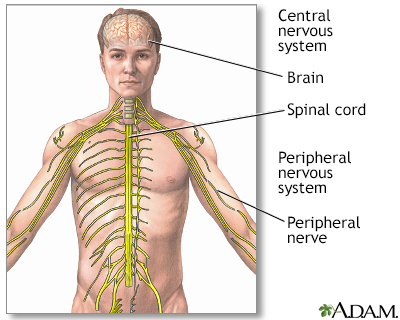
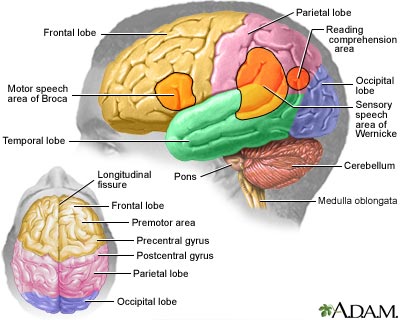
I Would Like to Learn About:
Causes
Normal aging can cause some forgetfulness. It is normal to have some trouble learning new material or needing more time to remember it. But normal aging does not lead to dramatic memory loss. Such memory loss is due to other diseases.
Memory loss can be caused by many things. To determine a cause, your health care provider will ask if the problem came on suddenly or slowly.
Many areas of the brain help you create and retrieve memories. A problem in any of these areas can lead to memory loss.
Memory loss may result from a new injury to the brain, which is caused by or is present after:
- Brain tumor
- Cancer treatment, such as brain radiation, bone marrow transplant, or chemotherapy
- Concussion or head trauma
- Not enough oxygen getting to the brain when your heart or breathing is stopped for too long (anoxic brain injury)
- Severe brain infection (encephalitis) or infection around the brain (meningitis)
- Major surgery or severe illness, including brain surgery
- Sudden, temporary loss of memory (transient global amnesia) of unclear cause
- Transient ischemic attack (TIA) or stroke
- Fluid collection in the brain (hydrocephalus)
- Multiple sclerosis
- Dementia
Sometimes, memory loss occurs with mental health problems, such as:
- After a major, traumatic or stressful event
- Bipolar disorder
- Depression or other mental health disorders, such as schizophrenia
Memory loss may be a sign of dementia. Dementia also affects thinking, language, judgment, and behavior. Common types of dementia associated with memory loss are:
- Alzheimer disease
- Vascular dementia
- Lewy body dementia
- Fronto-temporal dementia
- Progressive supranuclear palsy
- Normal pressure hydrocephalus
- Creutzfeldt-Jakob disease
Other causes of memory loss include:
- Alcohol or use of prescription medicines or illegal drugs
- Brain infections such as Lyme disease, syphilis, or HIV/AIDS
- Overuse of medicines, such as barbiturates, opioids or hypnotics
- Electroconvulsive therapy (ECT) most often causes short-term memory loss
- Epilepsy that is not well controlled
- Illness that results in the loss of, or damage to brain tissue or nerve cells, such as Parkinson disease, Huntington disease, or multiple sclerosis
- Low levels of important nutrients or vitamins, such as low vitamin B1 or B12
Home Care
A person with memory loss needs a lot of support.
- It helps to show the person familiar objects, music, photos, or play familiar music.
- It is important to write down when the person should take any medicine or do other critical tasks.
- If a person needs help with everyday tasks, or if safety or nutrition is a concern, you may want to consider extended-care facilities, such as an adult family home or nursing home.
What to Expect at Your Office Visit
Your provider will perform a physical exam and ask about the person's medical history and symptoms. This will usually include asking questions of family members and friends. For this reason, they may be interviewed in-person or by phone.
Medical history questions may include:
- Type of memory loss, such as short-term or long-term
- Time pattern, such as how long the memory loss has lasted or whether it comes and goes
- Things that triggered memory loss, such as head injury or surgery
Tests that may be done include:
- Blood tests for specific diseases that are suspected (such as low vitamin B12 or thyroid disease)
- Cerebral angiography
- Cognitive tests (neuropsychological or psychometric tests)
- CT scan or MRI of the head
- Electroencephalogram (EEG)
- Lumbar puncture
- Positron emission tomography (PET) scan
- Genetic tests
Treatment depends on the cause of memory loss. Your provider can tell you more.
References
DeLuca GC, Griggs RC, Johnston SC. Approach to the patient with neurologic disease. In: Goldman L, Cooney KA, eds. Goldman-Cecil Medicine. 27th ed. Philadelphia, PA: Elsevier; 2024:chap 366.
Kirshner HS, Gifford KA. Intellectual and memory impairments. In: Jankovic J, Mazziotta JC, Pomeroy SL, Newman NJ, eds. Bradley and Daroff's Neurology in Clinical Practice. 8th ed. Philadelphia, PA: Elsevier; 2022:chap 7.
Knopman DS. Cognitive impairment and dementia. In: Goldman L, Cooney KA, eds. Goldman-Cecil Medicine. 27th ed. Philadelphia, PA: Elsevier; 2024:chap 371.
BACK TO TOPReview Date: 10/27/2025
Reviewed By: Joseph V. Campellone, MD, Department of Neurology, Cooper Medical School at Rowan University, Camden, NJ. Review provided by VeriMed Healthcare Network. Also reviewed by David C. Dugdale, MD, Medical Director, Brenda Conaway, Editorial Director, and the A.D.A.M. Editorial team.
 | A.D.A.M., Inc. is accredited by URAC, for Health Content Provider (www.urac.org). URAC's accreditation program is an independent audit to verify that A.D.A.M. follows rigorous standards of quality and accountability. A.D.A.M. is among the first to achieve this important distinction for online health information and services. Learn more about A.D.A.M.'s editorial policy, editorial process and privacy policy. A.D.A.M. is also a founding member of Hi-Ethics. This site complies with the HONcode standard for trustworthy health information: verify here. |
The information provided herein should not be used during any medical emergency or for the diagnosis or treatment of any medical condition. A licensed medical professional should be consulted for diagnosis and treatment of any and all medical conditions. Links to other sites are provided for information only -- they do not constitute endorsements of those other sites. No warranty of any kind, either expressed or implied, is made as to the accuracy, reliability, timeliness, or correctness of any translations made by a third-party service of the information provided herein into any other language.
© 1997-
2026 A.D.A.M., a business unit of Ebix, Inc. Any duplication or distribution of the information contained herein is strictly prohibited.
All content on this site including text, images, graphics, audio, video, data, metadata, and compilations is protected by copyright and other intellectual property laws. You may view the content for personal, noncommercial use. Any other use requires prior written consent from Ebix. You may not copy, reproduce, distribute, transmit, display, publish, reverse-engineer, adapt, modify, store beyond ordinary browser caching, index, mine, scrape, or create derivative works from this content. You may not use automated tools to access or extract content, including to create embeddings, vectors, datasets, or indexes for retrieval systems. Use of any content for training, fine-tuning, calibrating, testing, evaluating, or improving AI systems of any kind is prohibited without express written consent. This includes large language models, machine learning models, neural networks, generative systems, retrieval-augmented systems, and any software that ingests content to produce outputs. Any unauthorized use of the content including AI-related use is a violation of our rights and may result in legal action, damages, and statutory penalties to the fullest extent permitted by law. Ebix reserves the right to enforce its rights through legal, technological, and contractual measures.
